
By Deborah Kops, Sourcing Change
Looking for a global business services job?
Today’s GBS job seekers have a real problem beyond a choppy employment market. Not because they lack experience, ambition, or marketable achievements. The problem is that the content of the majority of GBS roles is hopelessly imprecise.
So here’s the conundrum.
One company’s GBS transformation leader is another company’s transition lead with a more prestigious title. One enterprise’s global process owner is another firm’s service delivery manager with a broader stakeholder map. One organization’s enterprise change leader is another organization’s finance shared services professional who has picked up enough HR, procurement, and technology adjacency to be dangerous.
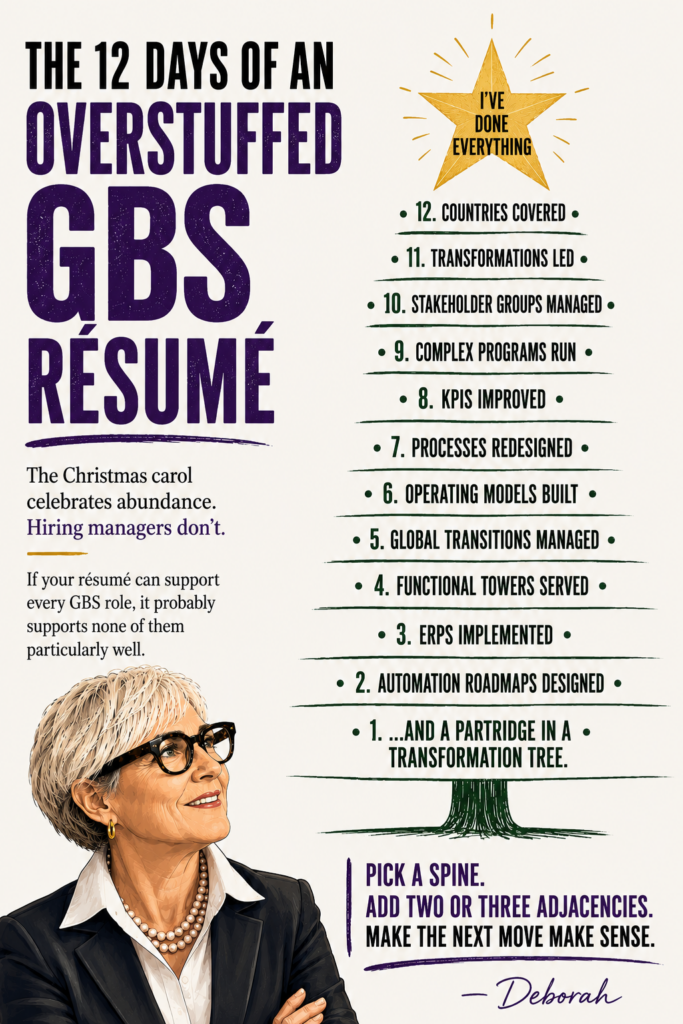
So candidates hedge. They write resumes that read like the lyrics to The Twelve Days of Christmas: five global transitions, four functional towers, three ERP implementations, two automation roadmaps, and a partridge in a transformation tree.
It is understandable but all-to-often ineffective in a job search. Here’s why:
- Candidates are trying to signal breadth; the hiring manager sees a jack-of-all-trades.
- Candidates are trying to prove they can stretch; the hiring manager sees role inflation.
- Candidates are trying to avoid being screened out in the first round; the hiring manager starts wondering what the candidate has actually delivered.
Why does it happen?
GBS roles are naturally amorphous because GBS is a model, not a function or a discipline. Role descriptions borrow from operations, finance, HR, procurement, technology, transformation, customer experience, change enablement, and vendor management. While the lack of precision is part of the magic of the model; it can create a hiring mess.
The same GBS title can mean radically different things depending on operational maturity. In an early-stage GBS, “transformation” can mean setting up governance, migrating work, building service catalogs, and getting the basics of service discipline in place while in a mature GBS, transformation might encompass end-to-end process ownership, digital enablement, enterprise productivity, and redesigning work across functions. In a cost takeout environment, the role might encompass moving work to a lower-cost location as fast as possible and calling it “strategy.”
GBS candidates are aware of this role ambiguity, so they hedge their bets by catering to every possible interpretation, especially in our tight job market. They worry about being pigeonholed as “just finance,” “just transitions,” “just operations,” or “just shared services.” So they add every adjacent experience they have ever touched, brushed against, supported, or heard discussed in a steering committee. Then the resume becomes defensive rather than directional, sort of like the proverbial “spray and pray.”
So resumes scream, “Please do not screen me out. I’m smart. I’m very versatile.” They do not say, “here is the role I am actually equipped to do….and pretty damn good at it.”
Why hedging doesn’t work
Stretching into a role is good. The best and most fulfilling GBS careers are built on stretch. The problem is unanchored stretch.
A finance shared services leader can credibly stretch into broader GBS role if they have delivered adjacent work, led cross-functional governance, managed enterprise stakeholders, shaped service management, or built common ways of working beyond finance. That is stretch with evidence.
But a finance leader who lists HR, procurement, IT, transformation, AI, experience design, global process ownership, outsourcing strategy, and operating model redesign because they were in meetings where those words were discussed is not stretching. They are accessorizing.
Hiring managers are not allergic to ambition; they are allergic to confusion. A resume that tries to be everything to all people raises three doubts in the mind of a hiring manager.
- What is the candidate’s core expertise? Every stretch should start from a believable center of gravity with a verifiable track record to match. Finance operations. Transitions. Service delivery. Process ownership. Transformation delivery. Commercial and vendor management. Some expertise has to serve as a spine.
- What performance was the candidate actually responsible for ? There is a difference between leading, contributing, influencing, advising, implementing, and being copied on the steering committee deck. Proximity is not ownership. Participation is not accountability. Being “part of the journey” is not the same as having your feet held to the fire.
- What kind of role is the candidate really ready for next? A resume should make the next move glaringly obvious, not turn the reader into an archaeologist.
Where GBS candidates can stretch honestly
The best stretch moves are usually one click away from the candidate’s proven base, not four clicks away.
A finance shared services leader can stretch credibly into broader GBS leadership when the target role needs operational discipline, scale, service management, process standardization, stakeholder management, and governance. The honest story is not, “I have run every function.” It is, “I have built the operating muscle that other functions now need.”
A transition leader can stretch into transformation when the role is about mobilizing change, managing dependencies, sequencing work, landing new ways of operating, and forcing decisions. The honest story is not, “I am an enterprise strategist;” it is, “I know how to move work, people, process, and governance from concept to reality.”
A service delivery leader can stretch into pan GBS leadership when they have run multi-function operations, managed demand, built stakeholder trust, improved service experience, and seen where elegant operating models fail when they meet real work. The honest story is not, “I designed the TOM.” It is, “I know where the TOM breaks.”
A process leader or GPO can stretch into GBS transformation when they have worked across functions, influenced technology, addressed data and controls, and changed behavior beyond their own process lane. The story is not, “I can transform the enterprise;” it is, “I understand how work flows across boundaries and how to redesign it without destroying the business.”
A BPO or vendor management leader can stretch into GBS strategy when they have shaped make/buy decisions, built governance, managed commercial levers, and understood where outsourcing helps or hurts the enterprise model. The honest story is not, “I am a GBS operator.” It is, “I understand the external delivery ecosystem and how to use it intelligently.”
Where stretch gets dangerous
Stretch becomes dishonest when the candidate confuses proximity with capability.
Being near a transformation is not the same as leading one. Participating in governance is not the same as designing governance. Supporting a migration is not the same as owning a transition. Sitting in automation conversations is not the same as delivering digital productivity. Working in finance shared services is not the same as being ready to run enterprise GBS.
This does not mean hiring managers are opposed to potential. They are trying to reduce risk. They need to know whether the candidate has actually done the work, led the work, or merely acquired the vocabulary.
A hiring manager can respect a candidate who says, “Here is my base, here is my adjacency, and here is the bridge.” They are much less forgiving when the candidate says, “I am everything you might possibly want, depending on which version of GBS you had in mind.”
That is not positioning. That is fog.
The better resume logic
GBS candidates should stop hedging and start positioning. That means three things.
- Anchor the resume in a real center of gravity. Finance operations. Transitions. Service delivery. Process ownership. Transformation delivery. Commercial and vendor management. Whatever it is, own it. And prove that you are able to perform.
- Show the adjacencies, but do not pretend they are core. Adjacency is powerful when it is specific. “Partnered with HR and procurement to build a common intake and service management model” is more believable than “led enterprise multi-functional transformation,” which may mean real ownership or may mean the candidate spoke on a conference panel.
- Name the stretch explicitly. A strong candidate does not need to fake perfect fit. They need to make the bridge easy to believe: “My background is finance shared services, but my last three roles moved me into broader GBS governance, cross-functional service design, and enterprise transformation delivery.”
That is not weakness. That is clarity.
In sum…
In GBS, stretch is not the exception. It is the career model. But stretch only works when it is honest, evidenced, and anchored.
The best candidates do not write resumes that sound like they have done twelve jobs vaguely. They write resumes that show one strong spine, two or three credible adjacencies, and a next role that makes sense.
Hedging your bets may feel like a good job search approach. But in a market already confused by amorphous roles, the candidate who wins is often the one who stops trying to sing the whole Christmas carol and finally tells the hiring manager what they are actually good at.