

By Deborah Kops
The GBS industry has spent the better part of two decades trying to solve a problem it may have inadvertently created.
We talk endlessly about end-to-end processes, “enterprise value,” integrated service delivery, and breaking down silos. We build operating models designed to connect functions. We establish governance structures intended to drive enterprise decisions. We create transformation programs to improve how work flows across the organization. We tell ourselves that the future belongs to organizations that can think and operate horizontally.
Then we recruit, develop, and reward people vertically.
We hire finance experts and ask them to become more proficient in finance. We hire HR experts and teach them more HR. We hire procurement experts and then build their procurement expertise. We hire technologists and track them to be mini-CIOs. We build career paths around functional depth, reward specialization, and organize ourselves into increasingly sophisticated towers. Then we launch transformation programs and wonder why nobody can quite connect the dots.
The surprise is particularly impressive given that we designed the problem ourselves. And, in light of implications of agentic, there is a burning platform for changing our talent construct.
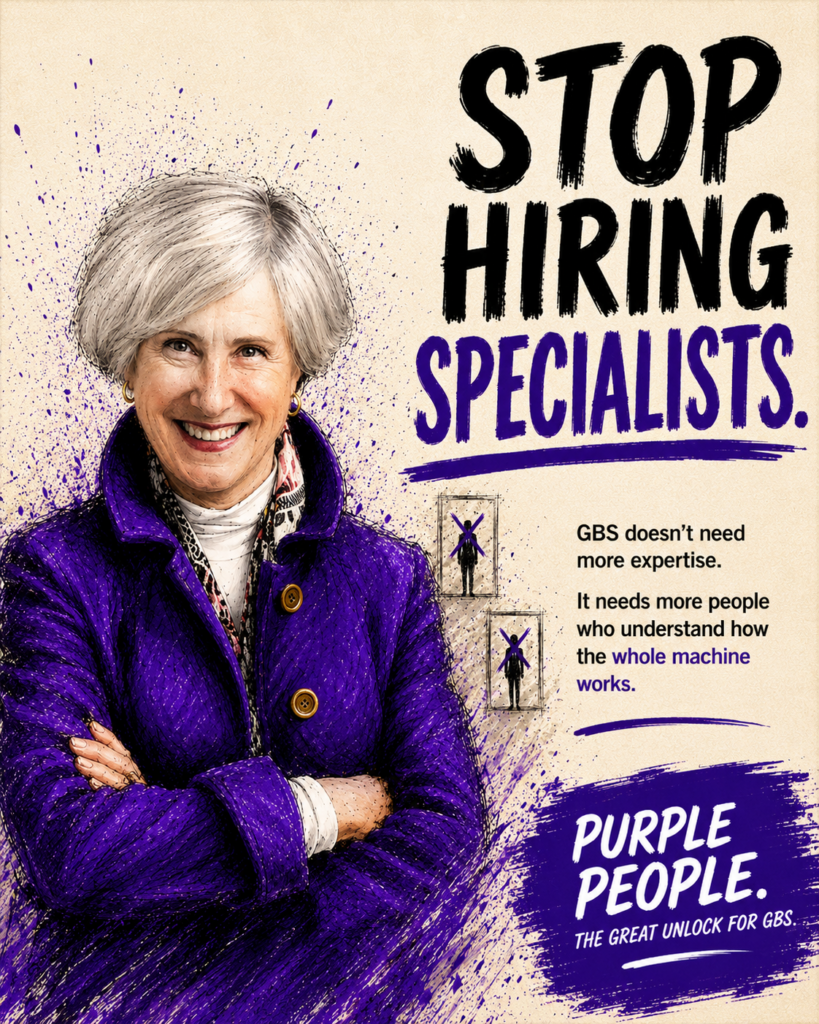
This is where purple people come in.
The term “purple people” has been floating around technology circles for more than twenty years. Originally it described the rare individuals who could bridge business and technology. Useful enough. But like many concepts born in IT, it undershoots the challenge facing modern GBS. Today’s purple people are not translators. They are orchestrators. They understand how the entire system of execution works—or should work.
Purple people understand that outcomes are produced by the interaction of process, technology, data, governance, talent, service experience, organizational design, and increasingly AI. They do not see these as separate disciplines to be managed independently. They see them as components of a single system. While specialists often become experts in a component capability or process, purple people become experts in the system.
That distinction matters because the challenges facing GBS are rapidly becoming less functional and more systemic. Most organizations no longer struggle because they lack technology. They struggle because technology is disconnected from process. Process is disconnected from accountability. Accountability is disconnected from incentives. Incentives are disconnected from outcomes. The individual components may all be functioning reasonably well, but the system itself is not.
This explains why so many GBS transformation efforts generate activity without generating meaningful change. New platforms are implemented while old ways of working remain intact. AI pilots are launched into broken processes. Automation projects reduce effort in one function only to create additional work somewhere else. Dashboards multiply while decision making speed and authority remains stubbornly unchanged. The issue is rarely the quality of the intervention. The issue is that somebody optimized a component rather than redesigning the system.
That should sound familiar to anyone in GBS because no part of the enterprise sees more of the organization than GBS. Finance sees finance. HR sees HR. Technology sees technology. GBS sits where all of them can meet. It sees where work starts, where it stalls, where it breaks, and where value leaks out of the system. If any function should naturally produce purple people, it ought to be GBS.
Yet many GBS organizations continue to develop talent through functional lenses. Career paths remain anchored in towers. Expertise remains tied to disciplines. Progression often depends on becoming deeper in a specialty rather than broader across the enterprise. The irony is hard to miss. An industry built around integration still develops many of its people for specialization.
Purple people are not anti-expertise. Most are highly credible in at least one domain. The difference is that they never stop there. They are just as interested in how technology shapes a process as they are in the process itself. They care as much about orchestration as they do execution. They are curious about customer experience, organizational design, data, talent, and increasingly AI. Not because they are collecting disciplines like merit badges, but because they understand that outcomes are created through the interaction of all of them.
The emergence of AI only amplifies the issue. Agentic technologies do not care who owns a process. Digital workers do not respect organizational charts. Intelligent workflows move across functions, systems, and geographies because the work itself moves across functions, systems, and geographies. In many respects, the future operating model looks more like GBS than it does the traditional enterprise. The question is whether GBS talent constructs will evolve quickly enough to take advantage of it.
The uncomfortable reality is that many organizations continue to recruit for yesterday while talking enthusiastically about tomorrow. They speak endlessly about transformation, AI, enterprise value, and digital operating models, yet continue to define talent through the lens of functional expertise. Put differently, many organizations are preparing for the future by hiring people whose primary qualification is success in the past.
The people needed for the future are often already there. They are the individuals who never seem to fit neatly into a single category. They move comfortably between functions. They connect ideas that were never intended to meet. They ask awkward questions about why work exists in its current form and why seemingly unrelated problems keep producing the same outcomes. They are often harder to categorize than specialists and therefore easier to overlook.
That may be the biggest mistake of all.
The GBS industry spends a remarkable amount of time talking about operating models. We debate governance structures, service catalogues, sourcing strategies, automation roadmaps, location footprints, customer experience, and now AI. Every year the diagrams get more sophisticated. Every year the maturity models become more detailed. Every year the technology demonstrations become more impressive.
Yet the organizations that consistently outperform their peers are rarely distinguished by a box on an organization chart or a particular governance mechanism. More often than not, they have figured out how to identify and develop the people who can see across the system and connect what others treat as separate problems.
As AI becomes embedded into workflows and digital labor begins operating alongside human labor, that capability becomes more important, not less. The future will belong to organizations that can combine technology, process, governance, data, and talent into a coherent system of execution. That sounds suspiciously like a GBS challenge.
The industry has spent years debating GBS operating models. It may be time to spend a little more energy thinking about who operates them. It’s the great unlock.
Call it purple people.