
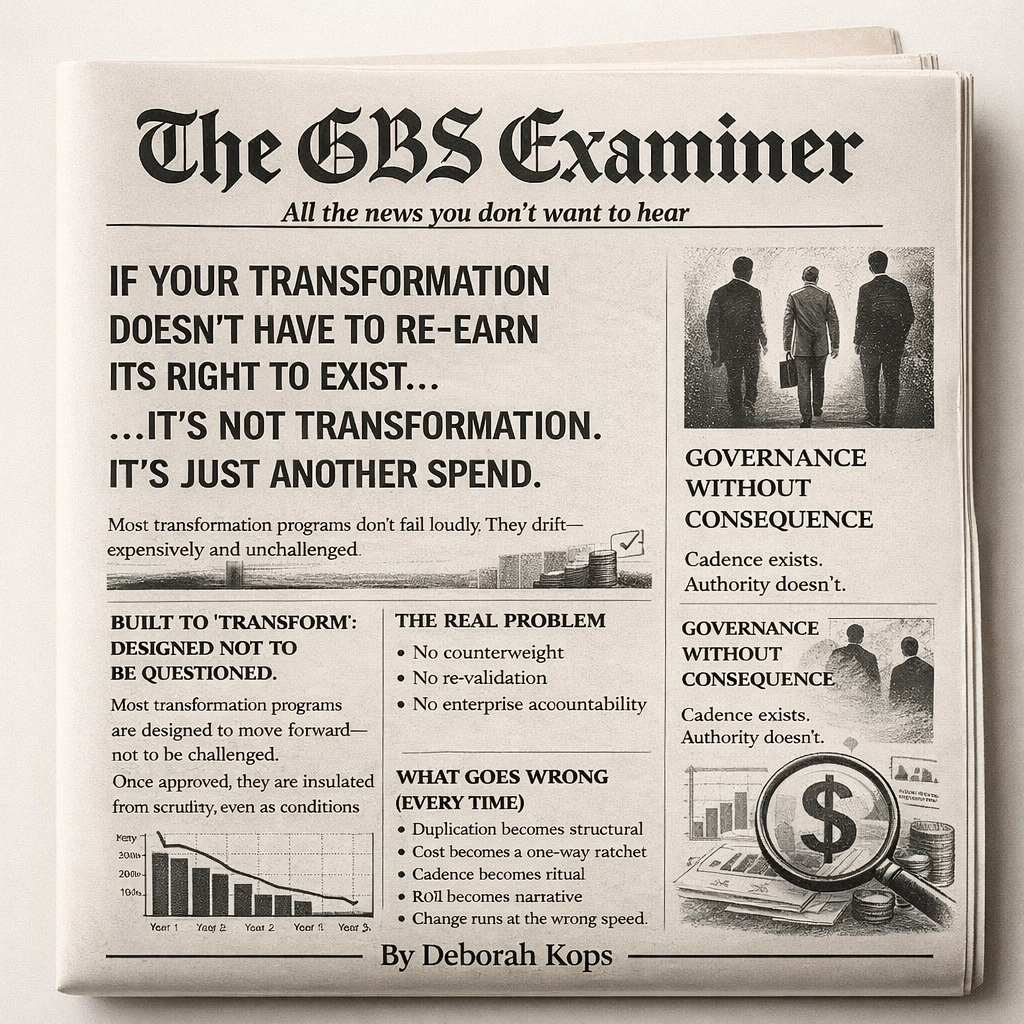
By Deborah Kops, Sourcing Change
There’s a quiet fiction that sits at the heart of most transformation programs–GBS or otherwise. We pretend that once the PowerPoint is approved and the funding envelope is agreed, the hard part is done. The machine will now run. Benefits will follow. Leaders will execute.
And so we hand the keys to a transformation lead, wish them well, and step back.
What follows is not governance. It’s abdication.
The myth of the self-governing transformation
Most transformation programs are designed as if momentum is a substitute for control. They are launched with fanfare, wrapped in multi-year funding commitments, and insulated from scrutiny under the banner of “strategic importance.”
In reality, they drift almost immediately.
Not because the people driving change are incompetent. But because the system is.
Transformation leaders are too often cast, whether implicitly or explicitly, as judge, prosecutor, jury, and executioner. They define the roadmap, approve the investments, track the benefits, and report the outcomes. There is no independent challenge function. No real counterweight. No mechanism to ask, with any rigor: should we still be doing this? With the same approach?
Then five things happen. Every time.
What goes wrong (predictably)
1. Duplication becomes structural, not accidental
In the absence of governance with teeth, duplication isn’t eliminated—it’s legitimized.
Multiple workstreams solve the same problem under different banners. Finance transformation reinvents data models already tackled in IT. HR redesigns workflows already standardized in a global services organization. Automation teams build parallel solutions because no one is arbitrating reuse. Costs inadvertently go up.
No one is accountable for the enterprise view of work; only their slice of it.
Duplication persists not because it’s invisible, but because it’s unchallenged.
2. Cost becomes a one-way ratchet
Transformation programs are famously “fully funded,” often for multiple years, based on an initial business case that is, at best, directional.
But here’s the sleight of hand: once approved funding is rarely revisited with any seriousness.
There are no real go/no-go gates. No requirement to re-earn the next tranche of investment. No disciplined comparison of forecast vs. actual.
Instead, cost becomes a ratchet:
- New initiatives are layered on
- Legacy activities and tools are slow to retire
- Savings are projected, not harvested
The program grows. The enterprise pays. And the original economics quietly dissolve.
3. Cadence becomes ritual, not control
Governance forums exist. Of course they do. But when they are institutionalized, most are what I call tea ceremonies: highly structured, well-attended, and almost entirely performative.
Status is reported. Slides are reviewed. Risks are noted. And nothing meaningful is decided.
Why? Because the forum lacks authority.
No one in the room can:
- Stop a failing initiative
- Reallocate funding across functional or business unit silos
- Enforce standardization over local preference
Cadence without consequence is not governance. It’s theater.
4. ROI becomes narrative, not fact
Ask most transformation leaders how benefits are tracking, and you’ll get a confident answer.
Ask them to prove it, and the room goes quiet.
Benefits are often:
- Modeled, not measured
- Attributed, not verified
- Aggregated, not traced to specific interventions
And critically, they are rarely challenged by an independent party.
The same team that designed the business case is marking its own homework.
It’s not malicious. It’s just human nature. But it means ROI becomes a story we tell ourselves, not a number we can defend.
5. Change moves at the wrong speed (or not at all)
Here’s the piece most programs miss, and governance is exactly where it should live.
In the absence of real oversight, transformation runs at the pace of the program, not the pace of the enterprise.
Workstreams push forward to hit milestones. Leaders report progress against timelines. Deliverables are declared “complete.”
But stakeholders–the very people who actually have to live with the new model–are on a different clock entirely.
They absorb change in waves:
- Some move quickly
- Some lag
- Some quietly resist
- Some rebuild what you just removed (aka “the curse of shadow organizations”)
Without governance that explicitly monitors and manages rate of adoption, two equally damaging patterns emerge:
- Overdrive: The program moves too fast, overwhelming the organization. Adoption collapses, workarounds proliferate, and confidence erodes.
- Underdrive: The program slows to accommodate resistance, dragging timelines while costs continue to accrue. Momentum fades, and the change loses credibility.
In both cases, the root issue is the same: no one is accountable for calibrating the pace of change to the organization’s capacity to absorb it.
Change management, in this context, isn’t a communications plan. It’s a governance discipline.
If governance isn’t actively:
- Measuring adoption (not activity)
- Identifying where the model is being bypassed
- Intervening when pace and capacity are misaligned
…then the program is simply hoping the organization catches up.
It rarely does.
The root problem
Strip all of this back, and the issue is brutally simple:
Transformation is being governed by the people most invested in its continuation.
There is no independent line of sight on:
- Whether the work is still relevant
- Whether the economics still hold
- Whether the enterprise is actually changing
- Whether the organization can realistically absorb what’s being pushed at it
We have confused delivery oversight with enterprise governance.
They are not the same thing.
What fixing it actually requires
Not more meetings. Not better dashboards.
It requires a structural reset.
1. Install a true counterweight: the chief transformation officer
If transformation is material to the enterprise—and it almost always is—then it deserves executive oversight with real authority.
Call it a Chief Transformation Officer if you like. Not as a program lead, but as a governor of all enterprise transformation as a portfolio.
This role must be explicitly separate from execution.
Its mandate is to:
- Challenge scope and sequencing
- Validate (or invalidate) business cases
- Reallocate funding across initiatives
- Stop work that no longer makes sense
- Intervene when pace outstrips organizational readiness
In other words, to act in the interest of the enterprise—not the program.
2. Introduce governance with teeth
Governance must move from observation to decision.
That means:
- Hard stage gates tied to funding release
- Mandatory re-justification of initiatives at defined intervals
- Cross-functional arbitration on duplication and reuse
- Explicit oversight of adoption and change velocity
And critically, decisions must stick.
If the governance body cannot say “no,” and have it mean something, then it isn’t governance.
3. Treat program funding as earned, not granted
Multi-year blank checks are the enemy of discipline.
Funding should be:
- Phased, not front-loaded
- Conditional, not assumed
- Competitive, not siloed
Each tranche of investment should be earned based on:
- Demonstrated progress
- Verified benefits
- Continued relevance
- Proven adoption, not just delivery
This is not about starving transformation programs. It’s about forcing them to stay honest.
4. Separate benefit validation from benefit delivery
The team that delivers the change should not be the sole arbiter of its success.
Introduce an independent validation function—whether in Finance, Strategy, or a dedicated transformation office—that:
- Tracks benefits at source
- Reconciles them to financial outcomes
- Challenges attribution
If you can’t easily trace benefits directly to the P&L, they don’t exist.
5. Link change to consequence
Adoption is not a communications problem. It’s a governance problem.
The new model must be enforced through:
- Clear decision rights
- Removal of legacy pathways
- Alignment of incentives and performance management
- Intervention when adoption lags or resistance hardens
If people can opt out of the new way of working without consequence, they will.
Every time.
The hard truth
Most transformation programs don’t fail because the ideas are wrong.
They fail because no one is truly in charge of the enterprise outcome.
We distribute responsibility across workstreams, vendors, and functions and then act surprised when no one owns the whole.
Governance is supposed to solve that.
But only if it has the courage–and the authority–to intervene.
If your transformation doesn’t have to re-earn its right to exist…
…it’s not transformation. It’s just another spend.