
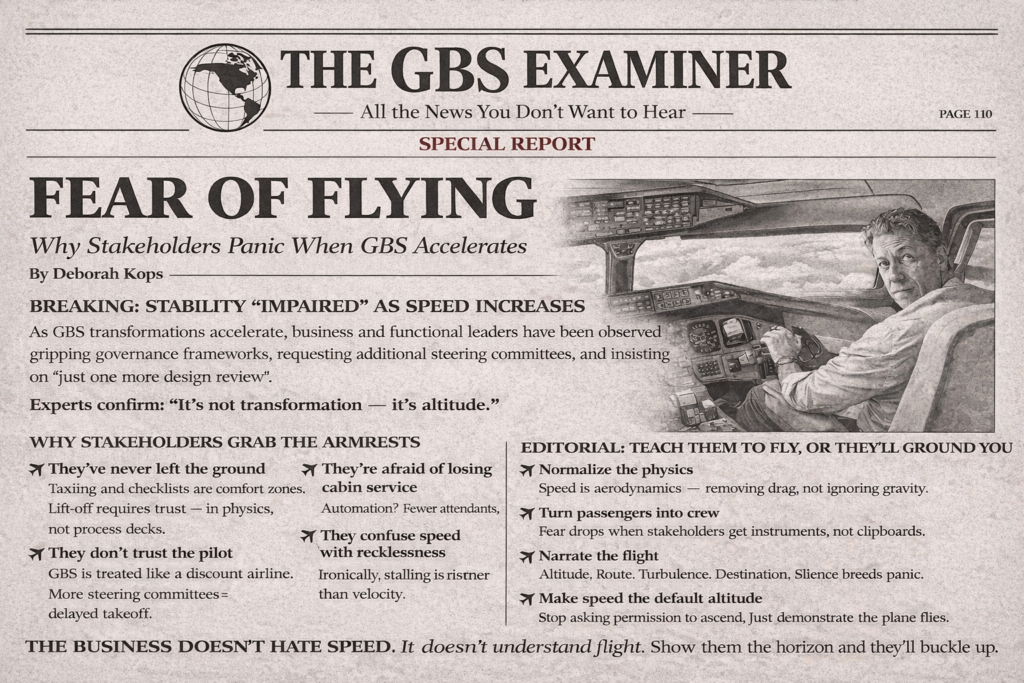
By Deborah Kops
Speed to value sounds sexy and agile in the boardroom until it’s real. The moment GBS transformation starts moving faster than the enterprise’s comfort zone, the functions and the business clutch their clipboards and mutter about “stability.” It’s not transformation itself that they fear. It’s altitude.
Bear with me. Flying is an apt analogy.
Why do passengers grab onto their armrests?
- They’ve never left the ground.
The business and functions have spent decades taxiing — running checklists, filing flight plans, optimizing the runway. Speed means lift-off, and lift-off means trusting the air to hold you. That’s a terrifying concept for anyone who’s lived in compliance mode for donkey’s years. Or have never traveled beyond the front door of the enterprise. - They don’t trust the pilot.
GBS is often seen as a new airline with a questionable or limited safety record. When the transformation takes off, the functions or the business glance nervously at each other: Do these folks even know how to fly the plane? Cue demands for more governance, more steering committees, more runway lights, more design authorities — anything to slow takeoff. - They’re afraid of losing cabin service.
Fast flight changes the experience. No more bespoke catering, no special favors from the flight crew. In GBS terms: standardization, automation, and global delivery mean less pampering. And who wants to fly economy when they’re used to first class? - They confuse speed with recklessness.
In their minds, faster means riskier. Stakeholders see acceleration as cutting corners, not cutting waste. The irony? The real danger isn’t flying; it’s stalling mid-air because decision-makers can’t stomach the pace. - They can’t handle the view from 30,000 feet up.
End-to-end visibility is disorienting for the enterprise. Suddenly you can see the entire process — where functions add drag instead of lift, where the business isn’t willing to stay in their seats. For many stakeholders, that level of transparency feels like turbulence.
The antidote? Teach them how to fly.
- Normalize the physics.
Explain that GBS speed isn’t about recklessness; it’s about aerodynamics — stripping out drag (bureaucracy, redundancy, hero culture) so that the enterprise can actually stay airborne. - Turn passengers into crew.
Bring the business and functions into the cockpit. Co-design metrics, share control surfaces, and let them experience what agility feels like from the pilot’s seat. Fear fades when people have instruments in their hands. - Ensure the passengers understand the flight plan.
A good pilot narrates the flight. Explain the route, the expected turbulence, the speed, and altitude– and most importantly, what the destination looks like when the plane lands. When stakeholders can picture how the GBS model will function on arrival, they stop reacting to every bump as if it’s a nosedive. - Make speed the default altitude.
Don’t ask for permission to accelerate. Model it. Run sprints that deliver visible wins. The more you demonstrate that the plane flies safely — and gets to value faster — the less anyone will long for the tarmac. - Treat turbulence as a sign of progress.
Every transformation worth doing will shake like a plane in an updraft. The key is to keep communicating: altitude, course, ETS, weather ahead, expected delays or rerouting. The silence between updates is where fear creeps in.
Last word
The business and functions don’t hate speed; they just don’t understand flight. Your job as a GBS leader or transformer isn’t to argue about aerodynamics
It’s to get them to look out the window, see the horizon, and realize they’re already airborne.